A Bond Not Easily Broken

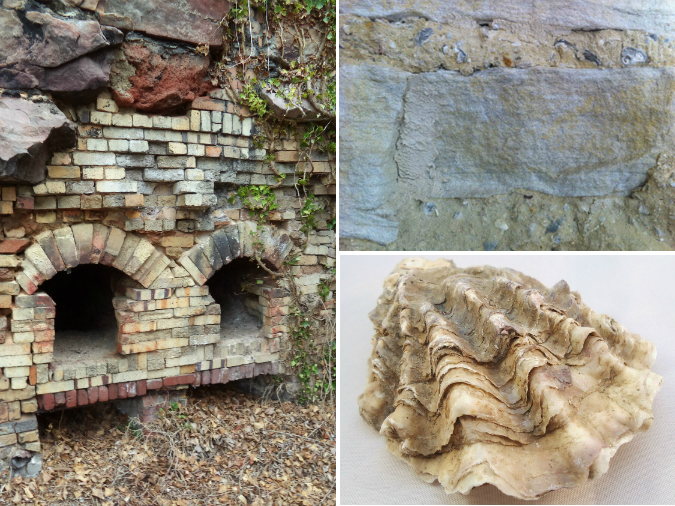
Lime mortar made with oysters

Photos, clockwise from left: Abandoned lime kiln in Virginia by Abandonedcountry.com, oyster shells in lime mortar by Jacqui Newling © HHT, oyster shell by BeaKez

So what was the “glue” with which the earliest settlers built their fieldstone homes?

Clay or clay mixed with chopped straw or animal hair would have been used to build the earliest foundations and interiors of chimneys, but this concoction would not have been strong enough to waterproof walls, fill gaps between stones and act as a cushion as walls settled. For that job, settlers needed lime, which when incinerated in a kiln and reduced to ash, was mixed with water and sand to create a superior mortar. The best sources of lime in early America? Natural lime deposits and seashells, whether combed off the beach or removed from an abandoned Native American rubbish heap (also called a kitchen midden).

So when we boil it all down, we may have both the land and the sea to thank for old stone homes.

Resouces:
The Early Domestic Architecture of Connecticut by J. Frederick Kelly
Indiana Folklore: A Reader, edited by Linda Dégh
The Availability of Lime and Masonry Construction in New England: 1630-1733 by Paul B. Jenison

An Early German Stone Home Too Far Gone?

Endangered Old Stone Home Christian Herr II House Lancaster County

Christian Herr II House, Lancaster County, Pennsylvania, Photo, Lancasteronline.com

The Christian Herr II House, a two-story stucco-over-stone home located in Lancaster County, Pennsylvania, was just added to the 2015 Watch List of Most Threatened Historic Properties in Lancaster County by the Lancaster County Preservation Trust. The oldest portion of the home dates to 1734 and was built by the son of Christian Herr I, an early settler who built the Hans Herr House, the oldest original Mennonite meeting house still standing in the Western Hemisphere.

According ot owners Randy and Christine Andrews, who have been renovating the home for the past six to seven years, the home suffers from two bowed beams (one significantly cracked), deteriorating stone and mortar and the effects of poorly handled additions/alternations. The couple would like to demolish the home and build new, a plan recently approved by their local planning commission. The Andrews said existing details and materials would be salvaged for use in construction of the new home.

Local historians hope to come to a compromise with the couple: to save the oldest portions of the home (circa-1734 and 1760) and/or the most important architectural details, namely the original attic beams, entrance and cellar.

“Situated on the southern portion of the original 530 acres purchased from William Penn (1644-1718), this house is one of the oldest still standing of those built by the second generation of Lancaster County’s earliest settlers,” says the trust. “Even though changes have been made to this house over the years, it still reflects the Germanic architectural style of its roots.”

What would you do? Bear the financial burden and restore at all costs or raze and build a new home that reflects the past?

A Farmhouse Fashioned of Fieldstone

What is the oldest (still-standing) stone home in the United States? In a state-by-state series, we’ll explore that very topic while highlighting some of the country’s most magnificent structures. Delaware and a little stone farmhouse lovingly referred to as the “Old Swedes House” is the first stop in our tour.

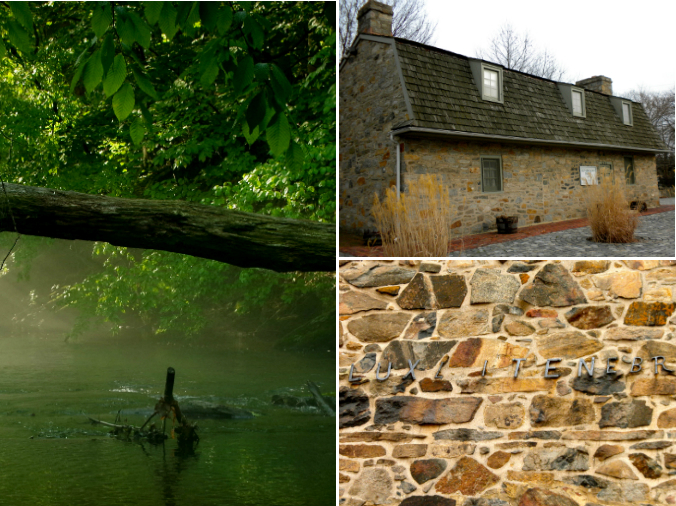
Hendrickson House Delaware

Photos, clockwise from left: Crum Creek by Thomas, Hendrickson House, Iron Lettering on Old Swedes Church

Hendrickson House, Wilmington, DE, circa 1690
This 1 1/2-story farmhouse was built by Swedish settler Hendrick Johansson as a wedding present for his son Anders. Originally nestled along the bank of Crum Creek (from the Dutch, meaning “crooked creek”) in Chester County, Pennsylvania, the home was dismantled in 1958 and rebuilt on its present site at Old Swedes Church.

Although Swedish settlers (the first to establish themselves in Pennsylvania) were credited with introducing the log cabin to America, this home was constructed of fieldstone, which would have been plentiful in and around the homesite. Hendrickson House is a fine example of Swedish Colonial style and originally featured one large room on the first floor and one large bedroom above. The home was owned by four generations of the Hendrickson family before it was sold in 1788 for use as housing for tenant farmers.

“The Crum Creek history reports that the stone house measured 30 by 20 feet and faced southwest overlooking Crum Creek and the Delaware River across to New Jersey. In the center of each of the two longer walls, front and back, was a door, flanked by a window on either side. The gambrel roof was supported by the end walls and by heavy, hand-hewn pine beams which extended two feet beyond the face of the front and rear walls to form protective eaves over the first floor doors and windows. Inside, the northwest wall was completely filled by a huge fireplace, an adjacent wood closet (fed by a hatchway to the outside), and in the right-hand corner, a narrow, winding stair leading to the second floor. The large upstairs room was used for sleeping quarters and was heated by a second fireplace.” Source: Genealogy.com