Historic Stone Landmarks at Risk

Saving old buildings seems a struggle, a tug of war between individuals who seek to preserve our heritage and those in charge of the structure, the land it sits on … or the purse strings.

Right now, two stone structures are at risk as groups involved in their care work to reach compromise.

Steuben House, Dutch Colonial, sandstone building, George Washington

The Steuben House in River Edge, New Jersey, is an excellent example of Dutch colonial style. The sandstone structure served as General George Washington’s headquarters in 1780. Source: Ken Lund.

The Steuben House, located at Historic New Bridge Landing in River Edge, New Jersey, is a Revolutionary War landmark, as it witnessed an important retreat from British forces led by Gen. George Washington on November 20, 1776, and also served as Washington’s headquarters for a time in 1780. The sandstone building, an excellent example of Dutch colonial architecture, is long overdue for repairs; talks are ongoing amongst parties involved: the Bergen County Historical Society, the state of New Jersey and the Department of Environmental Protection. Difficulty in raising funds to make repairs and improvements and disputes over types of improvements that can be made at the park have delayed progress.
Newburgh Dutch Reformed Church, Greek Revival Style, Alexander Jackson Davis, fieldstone church

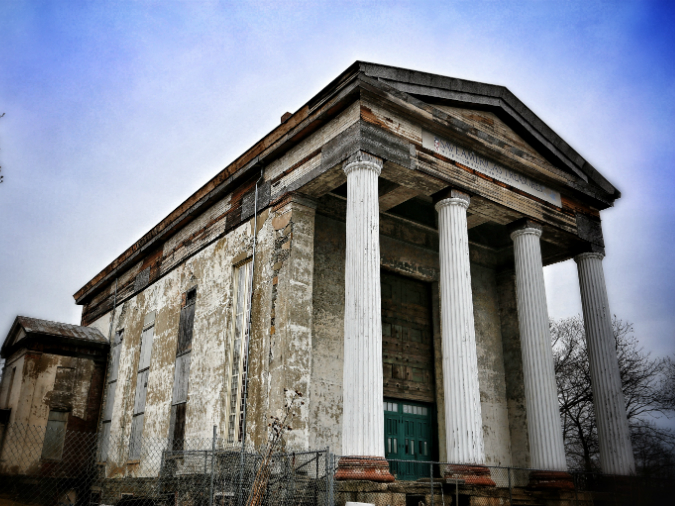
The Newburgh Dutch Reformed Church is a fine example of Greek Revival style. The endangered fieldstone building needs a new roof. Source: Abandonedhudsonvalley.com.

A New York state historic site in desperate need of TLC, the former Newburgh Dutch Reformed Church is an outstanding example of Greek Revival style. The church, designed by famed American architect Alexander Jackson Davis, was built in 1838 on a hill overlooking the Hudson River. The structure, reminiscent of the ancient Greek temple at Illissos, rests on a five-foot-high podium, features four 37-foot-tall columns and fieldstone walls that were once covered in stucco and painted to resemble stone. In recent years, wall and ceiling collapses have left the building vulnerable to decay and vandalism. Funds to stabilize a failing roof are desperately needed; the city of Newburgh and the Newburgh Preservation Association have reached out to Newburgh’s Community Land Bank for assistance.

Do you know of a historic stone structure that can’t seem to catch a break? Share with us!
 

When the World Gives You Lemons …

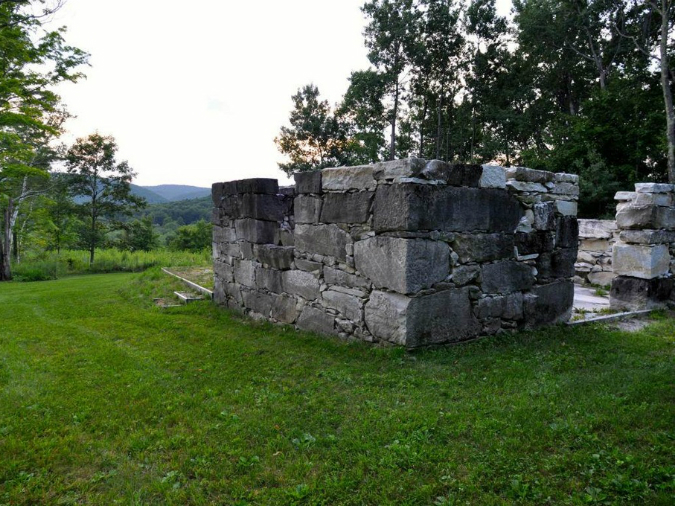
You’ve purchased a plot of land that happens to include the remains of an old stone structure (home, barn, mill, what have you). Maybe the walls are still standing and the roof is intact (although it’s about to cave into the structure). Or perhaps all that remains is the rubbled outline of a barn foundation.

old marble structure, stone ruins, Alford, MA

Thirty-five acre property that includes old marble structure, Alford, MA. Source: Zillow.

You certainly don’t have the funds to rebuild this home (although you may desperately long to). What to do? Don’t demolish, but incorporate the remains into a brand new structure.

Need some inspiration to get your creative juices flowing? Take a look at The White House, located on the Scottish Isle of Coll. A forward-thinking couple decided to shore up the walls of the abandoned stone home, and nestle their new eco-friendly home within it. The old stone walls protect the new structure from brutal winds while lending a sense of permanence to a modern structure built of locally sourced, low-impact materials.

old stone home, Scotland, adaptive reuse, new home in old stone home

A new eco-friendly home built within the remains of The White House, Isle of Coll, Scotland. Source: Wtarchitecture.com.

Springdale Farm, a circa-1837 estate located in Brinklow, Maryland, boasts European-style gardens planted within the confines of the property’s old stone bank barn, which was destroyed by fire in the 1940s. Its ruins were repointed to form the perimeter of the walled-in garden, where irises, peonies, roses, foxgloves, hybrid daylilies, baptisia, mums bloom.

Old stone ruins, bank barn ruins, garden inside old stone ruins

English gardens planted within remains of old stone bank barn, Springdale Farm, Brinklow, Maryland. Source: Dcmud.com.

On Pico, a remote volcanic island 800 miles west of Portugal, firm SAMI Arquitectos, in an effort to save 16th-century ruins, built a two-story concrete vacation home within the basalt stone walls of a long-since-decayed home. Four bedrooms are located on the ground floor, which in the stone home housed livestock.

old basalt stone ruins, new home in old stone ruins, adaptive reuse

New cement two-story vacation home built within the ruins of an old basalt stone home, Pico, Portugal. Source: Dezeen.com.

Back in the states, near Baltimore, Maryland, circa-1850s buildings (formerly part of the Poole and Hunt Foundry) house apartments, condos, office space and shops in a community coined Clipper Mill. The community pool is of particular note, as it is built within the the basement area of a former machine shop.

A community pool has been built within the ruins of a foundry in the Clipper Mill community, Baltimore, Maryland. Source: Thornhillbaltimore.com.

A community pool has been built within the ruins of a foundry in the Clipper Mill community, Baltimore, Maryland. Source: Thornhillbaltimore.com.

Have you salvaged old stone ruins? Or have you seen an absolutely extraordinary story of old stone homes and adaptive reuse? Share with us!

A Pro Stone President?

Thomas Jefferson, architecture, brick and stone construction

Founding father and third president Thomas Jefferson was a proponent of stone and brick home construction.

…We … will produce no permanent improvement to our country while the unhappy prejudice prevails that houses of brick or stone are less wholesome than those of wood … A country whose buildings are of wood can never increase in its improvements to any considerable degree. Their duration is highly estimated at 50 years. Every half century then our country becomes a tabula rasa, whereon we have to set out anew, as in the first moment of seating it. Whereas when buildings are of durable materials, every new edifice is an actual and permanent acquisition to the state, adding to its value as well as to its ornament.”

Thomas Jefferson was quite dismayed by colonists’ insistence on building timber-framed homes, of which he wrote, “It is impossible to devise things more ugly, uncomfortable, and happily more perishable.”

Ouch! Harsh words. But why all the masonry haters in early America? Back in the day, stone homes were considered a big no-no, at least if you spoke to early colonists who migrated to New England and the Tidewater region from southeast England. The reasoning was thus:

  • Stone and brick were considered poor insulators that let in cold air and damp conditions unless packed tightly together to form 2 to 3-foot-thick walls. Dew that gathered on thin interior stone or brick walls created an unhealthy living environment.
  • Lime used to make mortar was scarce, as were stone masons.
  • Lumber! Trees had to be cleared from a home site before construction could begin so why not use what was readily available?
  • Timber framing was familiar to this group, homesick and longing for reminders of the Old Country.
Cuckoos Farm Little Baddow, timber framed home, England

English colonists built homes to resemble those they left behind, like this 17th century home located near Chelmsford, England.

Parson Capen House, Topsfield Massachusetts, timber framed colonial home

The Parson Capen House, located in Topsfield, Massachusetts, is a fine example of 17th century New England architecture. The home bears a strong resemblance to houses in Toppesfield, England.

Who loved a cozy, solidly built stone home? Dutch settlers in the Hudson valley of New York and northern New Jersey, and German, Quaker and Scots-Irish settlers in eastern Pennsylvania. Each group constructed homes in farm styles similar to those they left behind in the Old Country. The best way to cure the damp caused by condensation, wrote Jefferson? Light a fire!

English stone cottage

This all-stone cottage, located in Northern England, would have served as a farmer’s home.

Samuel Fulton Stone House, Lancaster County, Pennsylvania, Irish settlers

The Samuel Fulton Home, originally located in Lancaster County, Pennsylvania, was patterned after old stone farmsteads that dotted the countryside in Northern England, Scotland and Ireland.

References:
Notes on the State of Virginia by Thomas Jefferson
Domestic Architecture of the American Colonies and of the Early Republic by Fiske Kimball
Early American Architecture: From the First Colonial Settlements to the National Period by Hugh Morrison

Old Stone Fireplaces: The Heart of the Home

old stone fireplace, granite fireplace, Old Rock House, Georgia, old stone homes

Old granite fireplace in the cellar of The Rock House, Thompson, Georgia. Source: Chasingcarolina.com.

It’s pretty safe to say we have an ongoing love affair with fireplaces. Who doesn’t ooh and ahhh at the site of chimney ruins or perk up at the very mention of a wood-burning fire. Aside from the crackle and pop of oily logs as they simmer in an open hearth, what draws us so keenly to these expansive structures? With blizzards lashing the East Coast and all eyes on the weather forecast, it seems a perfect time to focus on old stone fireplaces and their importance in the design of early American homes.

The earliest fireplaces were cut out of one side of a single-room dwelling, log cabin or cottage, with an exterior chimney of clay over a sturdy, upright stick frame. The interior was coated with more clay, mud or plaster to fireproof the structure. These so-called “Welsh chimneys” or “mudcat chimneys” were certainly a fire hazard and eventually gave way to sturdier structures of brick and/or stone.

In Colonial New England a centrally located chimney quickly became the norm. The stone column itself radiated heat while large fireplaces within the chimney faced out to each of two first-floor rooms. If the first floor was not at ground level, a fieldstone chimney would have been supported, underneath the first floor, by a load-bearing foundation of brick, fieldstone, rubble stone or a mixture of all three. The rectangular structure measured 5 to 10 feet on each side and featured timber “cradles” at the ceiling to further support the chimney. Oftentimes, a bake oven was installed inside this foundation.

central chimney, Hasley House, old historic homes

Example of central chimney, Hasley House, circa 1648, Southampton, New York.

In the Mid-Atlantic and Tidewater regions, chimneys were embedded in end walls or pushed to the outside completely. End chimneys served two purposes: to keep heat out of the home during summer months when the fireplace was used for cooking and to allow for a front and back door connected by a central hallway — and much-needed cross ventilation.

end wall chimneys, old stone chimneys, old stone homes

Example of end wall stone chimneys, Hezekiah Alexander House, circa 1774, Charlotte, North Carolina

Unique to the Delaware and Hudson Valleys and Dutch settlers was the “jambless” (sideless) fireplace comprised of a stone or dirt hearth, an iron, brick or stone backing to protect the wall behind it and a hood and chimney that led the smoke up out of the home. Bonus: Residents could sit on three sides of the fireplace. Drawback: The hood was an ineffective way to draw smoke out of the home.

old stone fireplace, granite fireplace, old rock house, Georgia, old stone house

Granite hearth, The Rock House, Thomson, GA. Source: Chasingcarolina.com.

Early stone fireplaces were massive (12 to 15 feet in width). Why? The fireplace served as a light and heat source (both day and night in cold weather), cookstove and storage space for a vast array of cooking equipment – spits, pots and more. Constructed of native stone, the fireplace featured an opening capped with a piece of timber or stone (lintel or “mantel tree”) from which cooking tools hung. From this lintel the formal mantelpiece evolved.

Although the stove replaced the open hearth as a means of cooking food, we are left with these lovely reminders of days gone by. And thanks to caring homeowners and historic preservation groups, examples of old stone chimneys and hearths will remain for generations to come.

Resources:
Early Cooking Hearths by Gregory LeFever
Early American Architecture: From the First Colonial Settlements to the National Period by Hugh Morrison
The Mabee House: Jewel of the Mohawk Valley
Colonials: Design Ideas for Renovating, Remodeling, and Building New by Matthew Schoenherr
American Architecture: An Illustrated Encyclopedia by Cyril M. Harris
Grandeur and Grace in the Ohio Country; Building America from the Ground Up, 1784-1860 by William E. Firestone

A Quaker Estate That Grew From a Humble Log Cabin

The Richard Wall House, circa 1682

The Richard Wall House, circa 1682. Source: Eric and Noelle Grunwald.

We have a devote Quaker to thank for the oldest stone home in Pennsylvania. Richard Wall came to America in the mid-summer of 1682, after purchasing 600 acres of land directly from William Penn. His land grant, along with 13 others, came to form Cheltenham Township, named after Cheltenham, England.

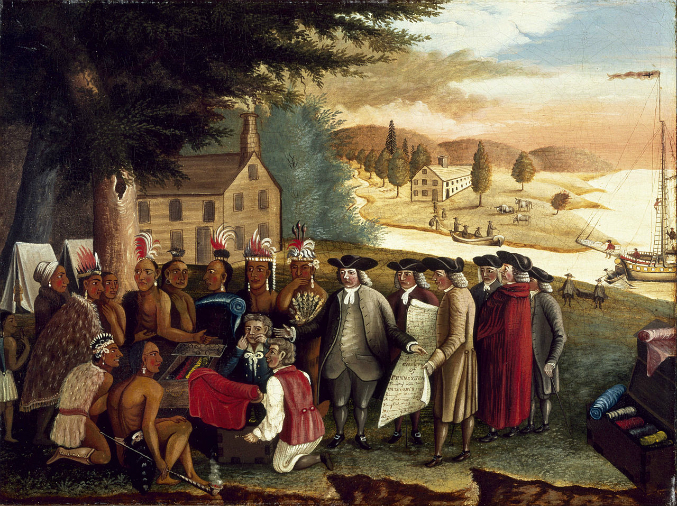
Penn's Treaty with the Indians

Penn’s Treaty with the Indians, c. 1830-1840, an oil-on-canvas painting by Edward Hicks

Wall’s home, coined “The Ivy” for the series of vines that once climbed its stone walls, certainly played its part in the early history of America. The humble Elkins Park abode served as one of the earliest Quaker meeting houses (and wedding/reception site for families within the congregation) and, later, a very important stop along the Underground Railroad.

And like most old stone homes in the states, the Wall House was a work in progress – at least for the first 245 years of its life. In 1682, shortly after arrival in Pennsylvania, Richard Wall built an 18’ x 30’ two-story log cabin with grey fieldstone end and fireplace. This style was in keeping with William Penn’s own suggestions on home style and construction and adapted from methods learned by the first wave of Quakers who migrated to New England during the 1650s-1670s and brought the building style back with them to England. (See our feature on construction method by region; New England stone enders). Subsequent tweaks and additions to the home came in 1730, 1760, 1760-1790 (when the log portion was removed), 1805, 1860 and 1927.

John Wormley's family home Camp Hill Pennsylvania

The original portion of the Richard Wall Home, constructed in 1682, may have looked quite similar to John Wormley’s family home, a circa-1769 log cabin located in Camp Hill, Pennsylvania.

After serving as the residence of four families, the property was purchased by Cheltenham Township in 1932 and served as the home of township managers. In 1980, the Cheltenham Township Historical Commission took the property under its wing and today operates a museum of local history at the site.

Resources:
Richard Wall House Museum
Restoration Offers House Historic Future by Rhonda Goodman

An Old Stone Cottage to Call Your Own

Who doesn’t love an old stone cottage, nestled on a hilltop or situated within a town’s historic district. For some, it serves as the entree into historic home ownership; for others (singles, couples minus kids and retirees) it’s the ideal way to live.

Today, we present some of the most adorable stone cottages currently on the market — all under $300K and circa 1900 or older. Looking to adopt a little stone dream home of your own? Take your pick from this batch of nine beauties. View in slideshow mode.

Artistry of the Early American Stonemason

Stonemasons, Fort Worth, Texas

Stonemasons, circa 1906, Fort Worth, Texas. Source: Hometownbyhandlebar.com.

The earliest American homes were built with stones gathered from open fields or unearthed while a farmer tilled his land. These stones were not shaped with tools, but cobbled together as-is, with mortar used to seal — and compensate for inconsistencies in stone shapes and sizes. The most smoothly faced stones were reserved for the exterior, front-facing sides of stone walls.

Once we had our footing in this new world, we refined the building process and quarried stones for home construction. Enter the stone mason. Once stone blocks were rough cut from the face of a rock quarry, the mason “dressed” or “faced” the stones to suit construction needs.

Old Stone Wall Types

Wall types, clockwise from top left: Fieldstone, rubble and coursed rubble. Source: stone.poplarheightsfarm.org.

To rough-face a stone, the mason first used a mashing hammer to trim away any projections that would prevent the stone from being laid in a straight line. Next, following straight lines he marked with a square, the mason would fine tune his work by trimming away additional stone with a pitching tool and mallet. To smooth-face a stone, a pick was used in place of a pitching tool.

Once all that pounding, trimming and chiseling was done, wall height and width were staked out with string, mortar (a “mud” made by mixing together lime, sand, hair and water) was prepared, trenches were dug and stones set in place, using smaller stones (i.e. gallets) to fill voids between stones and mortar to set the work in place. One part skilled craftsman and one part artisan, the stonemason could envision a design, face stones and then set them in a tightly woven, incredibly intricate pattern that required little mortar to stay put.

Old Stone Mill Rubble Style Stonework

Example of random-coursed rubble walls: James Mendenhall Mill, New Castle County, Delaware, circa 1826. Source: mchhistory.blogspot.com.

Rubble is probably the best example of early quarried and rough-faced stone. Rubbled stones retained their irregular shape and size, but required less mortar as they were precisely pieced together. Examples include random-coursed rubble, similar in appearance to a jigsaw puzzle, and regular-coursed rubble, which created continuous horizontal joints.

As masonry improved, rubble was replaced by tooled blocks that were used to build even-coursed walls. The stonemason would “sign” his artwork by chiseling his maker’s mark into an individual stone, cornerstone or lintel – a lasting reminder of his skill and craftsmanship.

Mason's Mark Cornerstone Old Stone Homes

Mason’s mark on quoin or cornerstone. Source: David Sankey.

Resources:
Masons and Bricklayers
Historic Stonework by William Kibbel III, The Home Inspector
Early American Architecture: From the First Colonial Settlements to the National Period by Hugh Morrison

A Connecticut Home With a Native American Connection

Henry Whitfield House Guilford CT

Henry Whitfield House by Jerry Dougherty

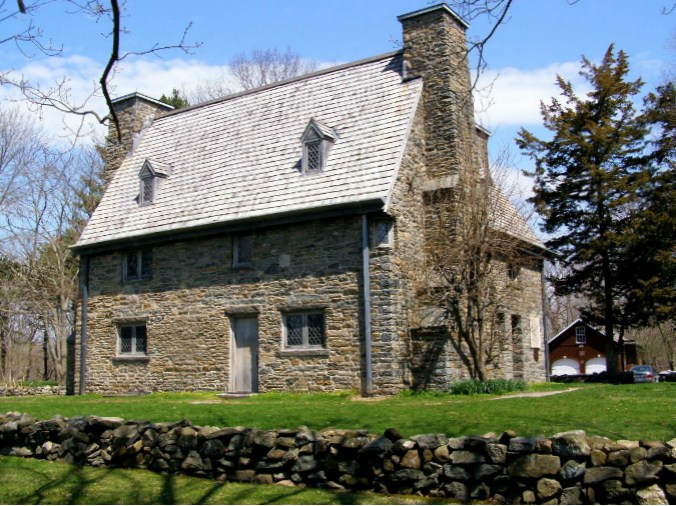
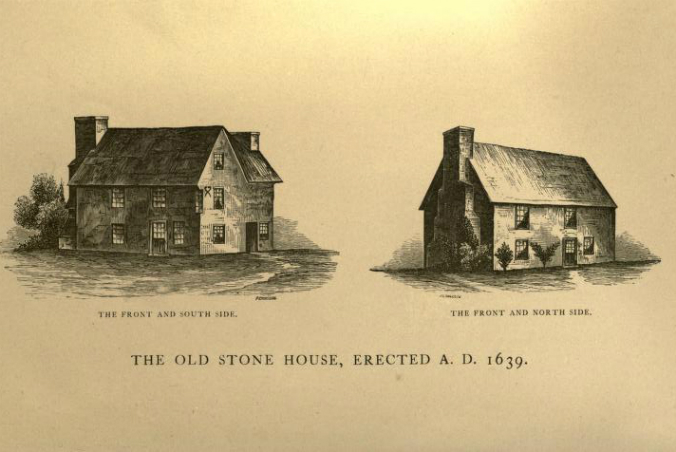
The Henry Whitfield House, located in the village of Guilford, is said to be the oldest dwelling in Connecticut and the oldest stone home in New England. It served as the family residence of Reverend Henry Whitfield, who, along with a group of Puritans fleeing religious persecution in England, founded the plantation of Menunkatuck (later, Guilford) in 1639.

Henry Whitfield House Guilford CT Early Illustration

Whitfield’s home is impressive for its time and location. The two-story structure (one of four stone homes that served as community leaders’ residences) doubled as a fort, a church and a gathering place for settlers. Fashioned in the post-medieval domestic style popular in England at the time, the home features 3-foot-thick battered stone walls, massive stone chimneys, a steeply pitched wood-shingled roof and casement windows.

What often goes untold is the story of the home’s connection to Native Americans. The land that comprises the original portion of the settlement was purchased from a female chief named Shaumpishuh. Her small band of 47 people, the Menunkatuck, derived from the larger Quinnipiac tribe; she sought to sell her tribal land in an effort to escape persecution from bands of warring Pequot and Mohawks.

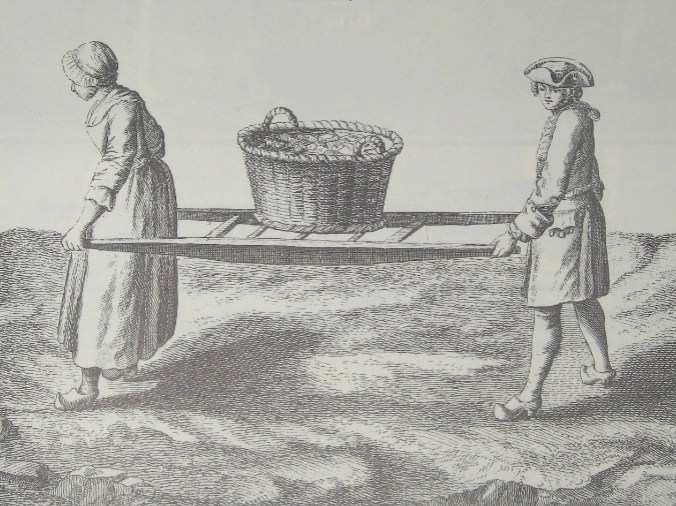
Example of Hand Barrow

And although carpenters, masons and home builders from neighboring settlements were called on to assist in the construction of Whitfield’s home, Native Americans who chose to remain behind after the land transfer bore the burden of hauling the heavy fieldstones to the home site. They managed this job by first gathering stones from a ledge called Griswold’s Rocks, piling them atop hand-barrows (example shown above) and carrying the heavy loads along an ancient causeway cut through a swamp to the home site, nearly 1/4 mile away.

We might conjecture that these native peoples also contributed to the home’s construction, as the majority of early settlers in Guilford were farmers (coined “planters” in early documents).

Resources:
The History of Guilford, Connecticut
A History of the Plantation of Menunkatuck
The Henry Whitfield State Museum
Henry Whitfield House Inventory of Records
Henry Whitfield House
Rev. Henry Whitfield
Oldest Stone House in New England: Henry Whitfield Museum

Old Stone Homes That Will Steal Your Heart

We scoured the market to find old stone homes that would suit the DIYer, someone who has a soft spot for all things early American. These magnificent examples of Colonial and Federal-style architecture are in need of serious TLC (and perhaps the demolition of an awkward addition or two). But just imagine the possibilities! Granted, each home is a bit off the beaten path, but definitely the makings of a great country getaway. Take a peek at our slideshow and tell us what you think!
A Bond Not Easily Broken

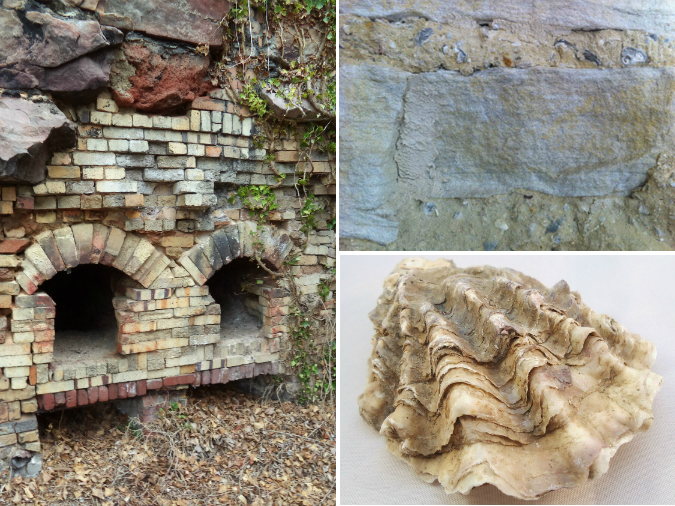
Lime mortar made with oysters

Photos, clockwise from left: Abandoned lime kiln in Virginia by Abandonedcountry.com, oyster shells in lime mortar by Jacqui Newling © HHT, oyster shell by BeaKez

So what was the “glue” with which the earliest settlers built their fieldstone homes?

Clay or clay mixed with chopped straw or animal hair would have been used to build the earliest foundations and interiors of chimneys, but this concoction would not have been strong enough to waterproof walls, fill gaps between stones and act as a cushion as walls settled. For that job, settlers needed lime, which when incinerated in a kiln and reduced to ash, was mixed with water and sand to create a superior mortar. The best sources of lime in early America? Natural lime deposits and seashells, whether combed off the beach or removed from an abandoned Native American rubbish heap (also called a kitchen midden).

So when we boil it all down, we may have both the land and the sea to thank for old stone homes.

Resouces:
The Early Domestic Architecture of Connecticut by J. Frederick Kelly
Indiana Folklore: A Reader, edited by Linda Dégh
The Availability of Lime and Masonry Construction in New England: 1630-1733 by Paul B. Jenison